




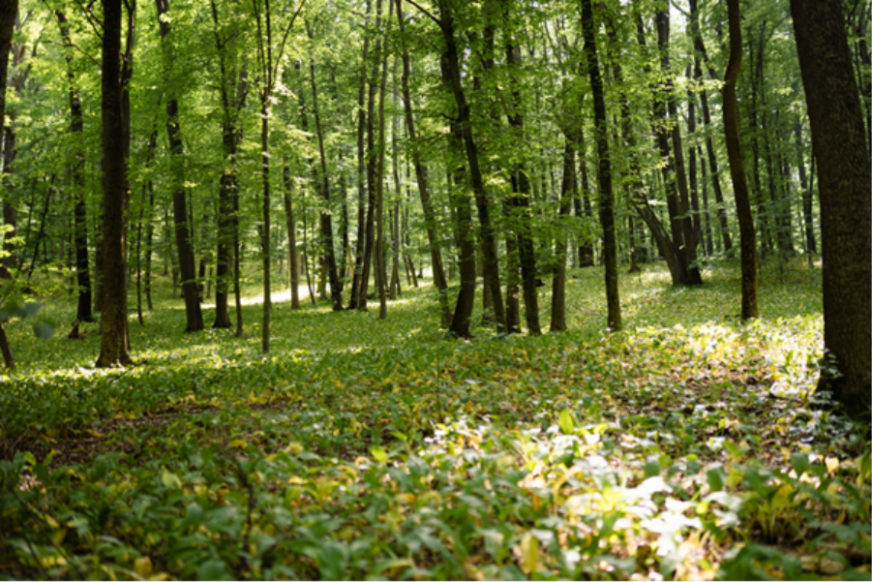
Plaiul Fagului (Beech Land). Photo by Vazy Production.
Rural economic growth – in Moldova and elsewhere – is evolving towards new nature-based activities. Nature reserves, such as Plaiul Fagului, can be a driver for local economies besides playing their traditional roles as sanctuaries for biodiversity. One example is the Beech Festival, held at Plaiul Fagului annually and organised since 2015. The festival attracts thousands of visitors, thus offering additional revenue for nearby villages. By investing in its forests, Moldova can create jobs and stimulate economic growth in the country’s rural areas.
Every spring for the last 13 years, the Beech Festival at Plaiul Fagului Nature Reserve draws local residents and visitors into the heart of Moldova’s ancient woodlands. Here, tradition and nature intertwine: vendors show off local crafts, rural economies find new life, and communities reconnect with their roots and grow new branches. In 2025 alone, the festival welcomed 3,500 guests, generating some €25,000 in income—vital support for both conservation and local livelihoods.
Supported by the European Unionand with the World Bank’s technical assistance, Moldova’s growing number of Emerald Network sites, such as Plaiul Fagului, are creating higher-quality jobs, attracting eco-tourists, and securing a sustainable future for rural communities across the country, while protecting essential biodiversity.
Through the regional “European Union for Environment” (EU4Environment) programme, at least 21 communities across the country are already part of this transformation. Together, they encompass more than 2 100 hectares of communal forest, 1 000 hectares managed under Forest Management Plans, and 500 hectares covered by silvo‑pastoral management planning. Of these, 19 communities are located close to the Beech Land Nature Reserve, reinforcing the connection between protected landscapes and everyday community life – from local livelihoods to cultural events shaped by the surrounding environment.
At the heart of these efforts are management plans developed for Emerald sites such as Nistrul de Jos, Codru, and Vrănești. These plans act as practical roadmaps, showing how forests and farmlands can be protected while continuing to support people’s livelihoods—through improved forestry practices, carefully developed eco‑tourism, and more sustainable use of natural resources.
The programme also supports nature’s own ability to recover. In five communities, naturally regenerated forest areas have been identified and formalised, alongside participatory forest management plans shaped with local stakeholders. A further eight communities are beginning to benefit from improved silvo‑pastoral planning, helping them use forests and pastures more sustainably, strengthen resilience to climate change, and create new income opportunities grounded in the landscapes they depend on.
Nature’s sanctuary
The Plaiul Fagului Nature Reserve is over 5,642 hectares of woodlands, including common and sessile oaks, wild cherry, hornbeam, and European beech.
Oaks form the backbone of the reserve’s ecosystems. A single mature oak can support over 300 different species, forming an inter-connected web of live from its canopy to the living soil beneath it. Invertebrates like beetles or caterpillars feed on the oaks’ leaves, bark, and sap, while birds nest in their branches and hollows.
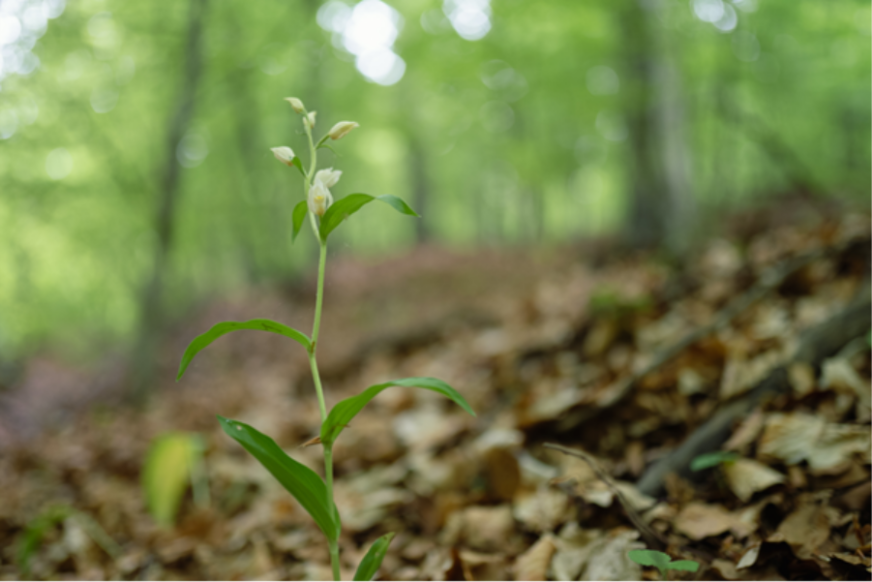
White Helleborine. Photo by Vazy Production.
Beech trees, from which Plaiul Fagului takes its name, are not dominant here today. Once more widespread, they now persist mainly in well-preserved stands within the reserve. As an edge population at the eastern limit of its natural range, these beeches remain crucial for genetic diversity and as as key seed-source trees for surrounding life.
With only 11% forest cover, Moldova relies on woodland remnants like Plaiul Fagului to boost rural areas’ resilience to natural hazards like storms or heatwaves, filter drinking water, and safeguard biodiversity with pollinators crucial for the country’s agriculture such as bees, butterflies, and birds. Promoting healthy forests isn’t just an environmental imperative then but an economic one.
Forests’ tourism potential
Just as the oak and beech sustain other species, Plaiul Fagului supports local livelihoods and shapes the cultural identity of surrounding communities.
At a bustling festival stall, Galina Cernei and her daughter Carolina offer jars of golden acacia and linden honey, each one a testament to the forest’s bounty. “No trees, no honey”, says Galina with a warm smile, capturing the simple truth that binds her family’s small business to the woodlands.
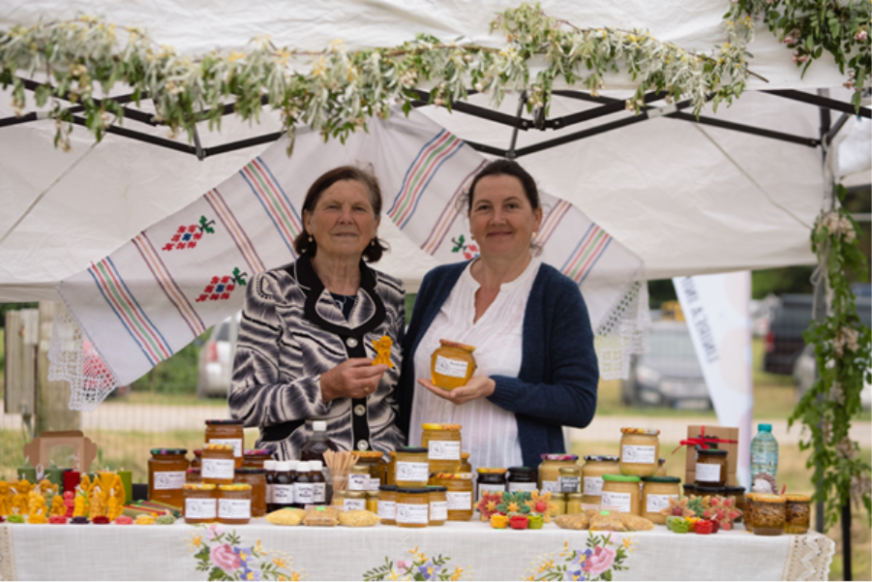
At the Beech Festival stand of Family Cernei. Photo by Vazy Production.
Ana Tarus and her local folklore group share dishes like vine leaves stuffed with field mushrooms. “We forage for these in the forest,” Ana explains. “Our group is a social coming-together over food and singing. As long as our forest exists, our folklore exists.”
Ludmila Ursatiev, who oversees economic development across the Ungheni District’s villages, sees Plaiul Fagului as a magnet for tourism that can stimulate economic growth and job creation. “Every village here should host at least one tourism enterprise,” she says. “Moldovans are wonderful hosts, they just do not see it as a business opportunity yet.”
That’s changing. The festival, which can draw 3,000-4,000 people annually, acts as a major stimulus for local commerce. And a new bridge across the Prut River will soon connect this region to Romania via a highway, promising even greater potential for tourism-fueled growth in rural communities, particularly through guesthouses, restaurants, wineries, and outdoor experiences like hiking trails and birdwatching tours.
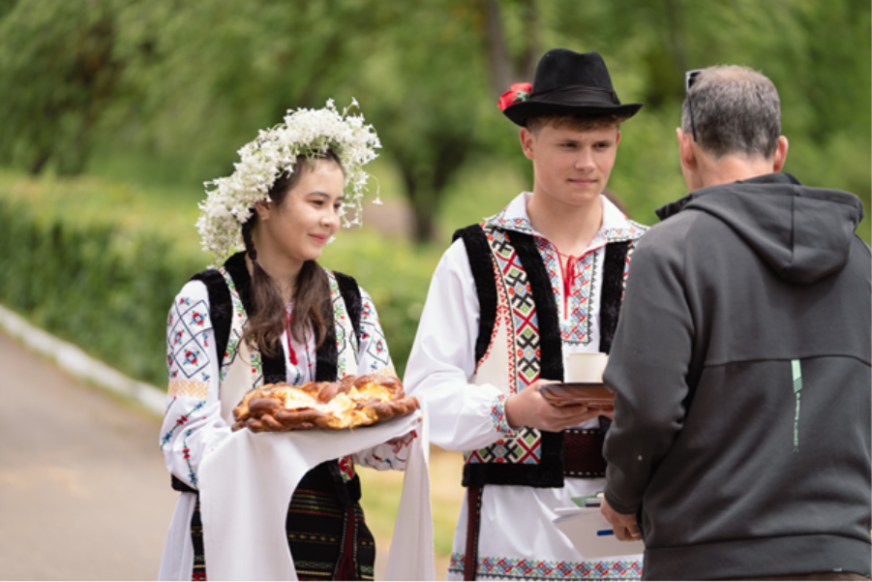
Welcoming guests with bread and salt and wine at the Beech Festival. Photo by Vazy Production.
Nature restoration for rural growth and better quality of life
“Plaiul Fagului is a brand,” says Veronica Josu from Moldova’s Ministry of Environment.
As part of its EU accession commitments, Moldova has pledged to expand its conservation network and enhance nature restoration efforts. Through a National Forest Extension and Rehabilitation Programme (NFERP) designed with EU’s support and World Bank’s technical assistance, Moldova aims to raise its forest coverage to 17% by 2032. Forest maintenance and restoration can employ thousands across Moldova’s rural areas, and sustainable harvesting can bolster the country’s timber industry. The afforestation efforts are complemented by a €215 million European Bank Investment loan, backed by an EU budgetary guarantee, to support the Moldova Forest Development Programme. The programme aims to restore about 63,000 ha of degraded lands and forests and strengthen sustainable forest management. In addition, an EU Neighborhood Investment Platform (NIP) grant of €15.8 million has been approved to complement the loan, helping enhance the project’s impact and financial sustainability.
“The European Union’s support has been instrumental in improving conservation policies and practices in Moldova,” Josu remarks. “We work to preserve what remains for future generations.”
Back at the festival, Galina acknowledges the challenges her rural community faces. Many young people have left nearby villages in search of work. “We left too once, but now we have returned. The future is uncertain. But we are hopeful.”
As the festival closes, local residents and tourists join hands in a circle dance, forming a living symbol of unity between people and nature. By preserving these precious woodlands, rural communities around Plaiul Fagului are forging a future where conservation and sustainability nurture job creation and prosperity. Across the country, forests can be a driver for local economies and an important contributor to quality of life.
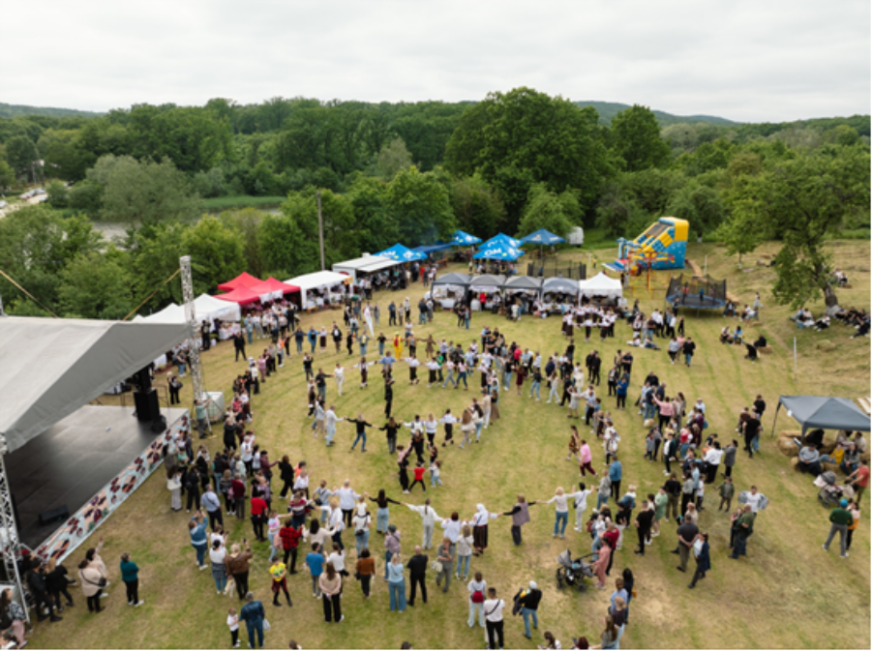
The Beech Festival – a view of the final circle seen from above. Photo by Vazy Production.