




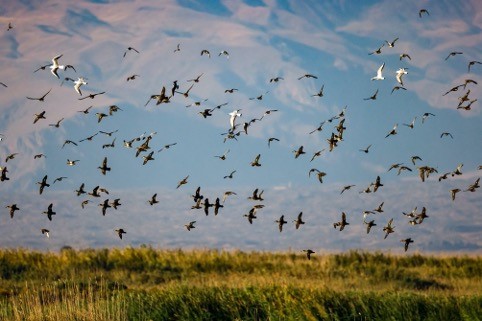
Birds of Armash. Photo credit: Berta Photography.
A Wetland Full of Life
As the morning sun rises, Anush Khachatryan, ornithologist at BirdLinks Armenia, an Armenian civil society organization, treads softly along a raised embankment. To her left, reedbeds rustling in a gentle summer breeze part to reveal stretches of blue water.
Suddenly, hundreds of waterbirds—gulls, lapwings, sandpipers, and herons among them—flap and flutter skyward. Anush raises her binoculars, spotting movement through the golden stems.
“There’s a white-headed duck,” she whispers, pointing to the endangered bird that breeds nowhere else in the country. Its striking blue beak is luminous in the morning light.
The scene is Armash wetland, at the heart of Armenia’s Ararat Valley, stretching across nearly 6,000 hectares. Home to over 200 bird species, including the globally endangered white-headed duck, and a critical stopover for more than a million migratory birds each year, it occupies a unique place in the country’s biodiversity conservation landscape. Beyond its ecological importance, the wetland has been central to the economies of nearby communities—who depend on its waters for fishing, agriculture, and seasonal harvesting.
Armenia, which is set to host the globally important COP 17 on Biodiversity in 2026, has made significant progress toward safeguarding a crucial habitat in Armash. The wetland is currently a candidate for the Emerald Network, which protects vulnerable and valuable species and habitats and extends European nature conservation standards beyond the European Union’s borders.
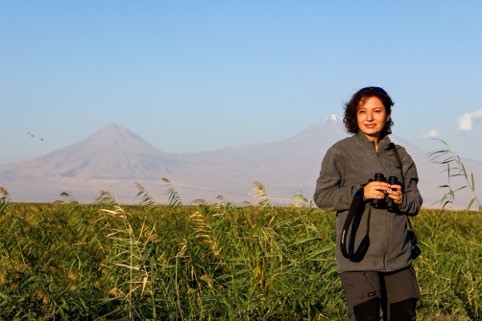
Ornithologist Anush Khachatryan. Photo credit: Berta Photography.
Its eventual adoption under the Emerald Network of protected areas would provide Armash with international recognition, avenues for additional funding, and access to technical assistance for conservation management.
Economic Vision
Armash’s success relies on a partnership between profit and protection. Artak Zadoyan, the owner of Armash Carp Farm CJSC, uses a business model that minimizes harm to wildlife while generating income, also called low-impact farming.
“We try to mix wildlife conservation with our business,” he explains, smiling, as some birds—notably the pelicans—help themselves to more than a few of his carp.
The farm’s avoidance of artificial fish feed was initially an economic decision to maintain agricultural tax status. Yet, it has created ideal conditions for birds by providing food for them.
In addition, Artak plans to dedicate a portion of the ponds to pesticide- and fertilizer-free rice production. Rice fields without chemicals will create safe foraging areas for waterbirds while producing healthy food for people.
Hunting is still permitted in Armash, and phasing it out requires careful negotiation with Armenia’s hunting lobby. Monitoring and protection are key. Nver Grigoryan, a site manager, patrols the wetland, keeping a watchful eye out for poachers. The ponds are strictly off-limits during breeding and migration seasons.
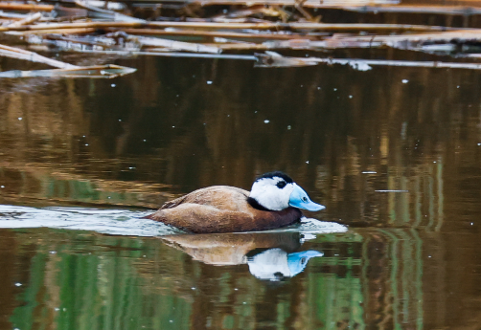
A white-headed duck. Photo credit: Berta Photography.
The results speak for themselves. BirdLinks Armenia reports that the population of the globally endangered white-headed duck has grown from just four breeding pairs in 2003 to 17 in 2024. Sightings of rare species—such as 23 flamingos in 2025—signal that Armash is becoming a haven for migratory birds.
Other rare species, such as the white-tailed lapwing, reside here and nowhere else in Armenia.
Growth through Ecotourism
The World Bank’s pilot management plan, developed under the EU4Environment Program, proposes replacing hunting with ecotourism and birdwatching as a long-lasting model for local economic growth. It sets concrete measures to address the current pressures and threats on the Armash habitats and species, while strongly considering the views and interests of local stakeholders. The plan proposes replacing hunting with birdwatching and ecotourism—a sustainable measure for both economic growth and long-term conservation.
The site already attracts experienced birdwatchers, “who have traveled the world,” as Anush describes them.
Visitors pay a $12 entrance fee and can now stay in a guesthouse on-site.
Nver also produces honey and harvests sunflower seeds, hoping to offer a farm-to-fork experience for visitors.
“It will be very good for the community,” he explains. “If a lot of tourists come to see the birds, there will be more opportunities to make money.”
Scaling Up the Model in Armenia
Armenia faces a landscape crisis: drainage over a century—particularly during the Soviet period—has devastated wetland ecosystems.
The urgency of work at Armash extends beyond this single wetland. It shows how local action and international support can reverse decades of wetland degradation. Nearly 100 hectares of wetland have been scheduled for restoration under the EU Restore4Life project, which will also develop birdwatching infrastructure and create space for the provision of hospitality and services by the local community. That could turn Nver’s hopes into reality. The World Bank’s $9.95 million RESILAND (Armenia Resilient Landscapes) Project supports forest and wetland restoration across other Armenian sites, including in the Ararat Valley.
Back on the embankment, Anush adjusts her binoculars and points to a family of pelicans huddled together on a small island. Marsh harriers glide overhead.
“Armash is one of the most amazing places I know,” she says.
With COP 17 around the corner, Armash highlights Armenia’s commitment to safeguarding its natural wealth.